Crystal healing · stone profile
Unakite
Unakite is a green/pink stone traditionally linked to self-love, release, grounding.
The essentials
- Family
- Rock (epidote + feldspar + quartz)
- Composition
- Composite
- Crystal system
- Variable
- Hardness (Mohs)
- 6–7
- Color
- Green/pink
- Chakras
- Heart
- Elements
- Earth
- Zodiac
- Scorpio
A granite that changed its mind
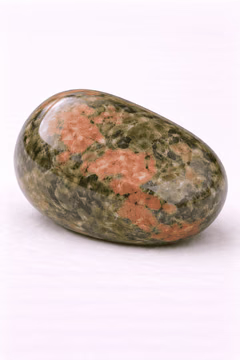
Unakite is an oddity in the crystal drawer: it is not a mineral but a rock, an assemblage of several minerals. It began as ordinary granite. Then hot fluids circulated through it and converted part of its components into epidote, a pistachio-green silicate. What is left alongside is orthoclase feldspar, salmon pink, and translucent gray quartz: three colors caught in the same paste, in patterns that never repeat.
It was described in 1874 in the Unaka mountains, straddling North Carolina and Tennessee, which is where the name comes from. You find it through the Appalachians, notably in Virginia, and as rolled pebbles on the shores of Lake Superior, carried there by glaciers. South Africa, Sierra Leone, Brazil and China produce it too.
Unakite, by tradition
Unakite marries moss green and tender pink in a single stone, like a landscape that reconciles two tints. Tradition ties it to inner balance, to gentleness toward yourself, and to the peaceful ability to let go of what no longer has its place. Its earthy colors call to mind a calm undergrowth, alive and rooted. Keep it near you as you write out your thoughts, or during a meditation. Hold it in your hand when you’re trying to settle and find your balance again, gently.
Affirmation“I find my balance gently.”
A tradition you can watch being written
Let us be straightforward: unakite appears in no ancient lapidary. Described in the late nineteenth century, absent from antique and medieval texts, it only enters the culture of stones in the twentieth. Its symbolism is young, and that is interesting in itself. You get to watch a tradition being assembled almost live, out of its colors and its link to the heart.
It has, on the other hand, a real career as an ornamental stone: it is cited among the stones facing the steps of the Smithsonian’s National Museum of Natural History in Washington. And on the beaches of Lake Superior, hunting for unakite pebbles is a small ritual handed down among walkers.
How to use unakite
Journaling, meditation.
Cleansing
A rinse, smoke, sound.
Charging
The earth, moonlight; intention.
Common questions
- Is unakite a stone or a rock?
- Technically a rock: an assemblage of green epidote, pink feldspar and quartz, born from altered granite. That mixture is precisely what creates its mottled, never-repeating patterns. In everyday crystal language people say stone, and nobody takes offense.
- How do I care for unakite?
- It is robust, its components sitting between 6 and 7 on the Mohs scale, and clear or lightly soapy water poses no problem. Avoid long soaks all the same: a composite rock always keeps fine seams between its minerals, and salt water or acids can dull the epidote.
- Is unakite sometimes called epidote?
- They are related but not the same. Epidote is the green mineral inside unakite; unakite is the whole rock, epidote plus pink feldspar plus quartz. A specimen sold as epidote should be green throughout, without the salmon patches.