Crystal healing · stone profile
Selenite (gypsum)
Selenite is a white stone traditionally linked to calm, intuition, focus.
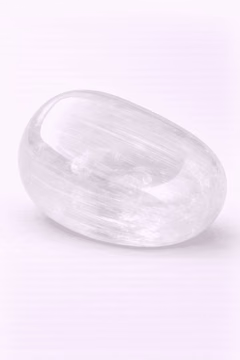
The essentials
- Family
- Gypsum
- Composition
- CaSO₄·2H₂O
- Crystal system
- Monoclinic
- Hardness (Mohs)
- 2
- Color
- White, translucent
- Chakras
- Crown
- Elements
- Air/Ether
- Zodiac
- Cancer
Gypsum, and the largest crystals ever found
Selenite is the clear crystallized form of gypsum, hydrated calcium sulfate, the same mineral that becomes plaster once you heat it. It is the mineral that defines 2 on the Mohs scale, which means your fingernail scratches it. One useful correction: most of the selenite wands sold in shops are fibrous gypsum, satin spar, with that silky lengthwise sheen. Same family, different texture.
Gypsum also holds a world record. In the Naica mine in Chihuahua, Mexico, the Cave of the Crystals holds selenite beams over eleven meters long, roughly thirty-six feet, among the largest natural crystals known. They grew over hundreds of thousands of years in water sitting near 50 °C. Commercial pieces come mainly from Morocco, Mexico and the Oklahoma salt plains.
Selenite, by tradition
Selenite is the stone of clear space and lightness. Tradition links it to an atmosphere that clears, to that sense of having made room to breathe and feel more easily. Its translucent white, silky and luminous, calls to mind a veil the light passes through without snagging. People love to set it in a meditation corner, sometimes as a slab where they rest other stones. Place it wherever you want to lighten the air, and let it invite you to empty out before you recenter. Keep it dry, since it likes to stay far from moisture.
Affirmation“I make room for clarity.”
Named for the Moon, used as window glass
The name comes from Selene, the Greek goddess of the Moon. Pliny the Elder already described a white translucent selenitis said to carry an image of the moon inside it, waxing and waning along with her, and that belief traveled through the medieval lapidaries more or less intact.
Translucent gypsum also had a thoroughly practical career. Split into thin sheets and known as lapis specularis, it glazed Roman windows before glass became common. Daylight entered certain villas through panels of selenite. It is hard to earn a reputation as a stone of light more literally than that.
How to use selenite
A meditation space; a plate to rest other stones on.
Cleansing
Sound, light smoke, a dry cloth (no water).
Charging
Moonlight, intention; keep away from moisture.
Common questions
- Can selenite go in water?
- Never. Gypsum is slightly soluble, so every contact etches the surface a little more. One quick splash will not dissolve your piece, but repeated wetting turns it dull, then chalky, then flaking. Dry care only: a soft cloth, and moonlight for charging if you like the ritual.
- Is selenite the same as satin spar?
- They are both gypsum, and the trade uses the names interchangeably, but they look different. Satin spar is fibrous with a silky cat’s-eye sheen and is what almost every wand, tower and charging plate is made of. Selenite proper is the transparent tabular crystal. Nobody is being cheated; it is loose vocabulary.
- Does selenite really cleanse other crystals?
- That is contemporary practice, not an old tradition, and nothing measurable happens on the plate overnight. What it does is give an evening a shape: rings and pebbles set down in one place, a small closing gesture at the end of a day. That structure is worth something on its own terms.
- Why does my selenite scratch so easily?
- Because at hardness 2 it is one of the softest stones you can own, softer than your fingernail. Nearly everything else in a collection will mark it. Store it on its own, away from quartz, and dust it with a dry cloth rather than rubbing.