Crystal healing · stone profile
Onyx (chalcedony)
Onyx is a black stone traditionally linked to grounding, protection, confidence.
The essentials
- Family
- Chalcedony (black agate often sold as onyx)
- Composition
- SiO₂
- Crystal system
- Trigonal
- Hardness (Mohs)
- 6.5–7
- Color
- Black, banded
- Chakras
- Root
- Elements
- Earth
- Zodiac
- Capricorn
Straight bands, and an honest word about the black
Onyx is a variety of chalcedony, the quartz whose crystals are too fine to see. What separates it from agate, its sibling, is geometry: straight parallel bands where agate curves. The name comes from the Greek onux, fingernail, for the milky translucency of its pale layers.
An honest note is due. The uniform black onyx of jewelry counters is nearly always gray chalcedony that has been dyed, by a sugar-and-acid process the Romans already used. That is not a scandal; it is a two-thousand-year-old convention of the trade. Chalcedony is mined in India, Brazil, Uruguay and Madagascar. As for the “Mexican onyx” of lamps and vases, that is banded calcite, an entirely different stone.
Onyx, by tradition
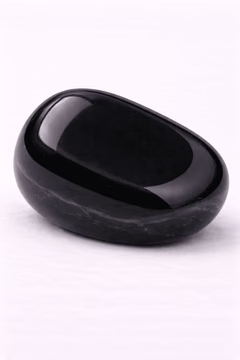
Onyx shows a dense, deep black, sometimes banded, with a smooth, reassuring surface. Tradition ties it to grounding, to a feeling of stability, and to the quiet ability to hold your boundaries. Its dark color calls to mind the earth at night, solid and silent underfoot. Slip it into a pocket, wear it as jewelry, or set it near the entrance like a steady presence. Hold it in the hollow of your hand when you’re trying to recenter and stay true to your space.
Affirmation“I hold my boundaries.”
Imperial cameos, and two opposite reputations
Onyx is the engraver’s stone. Its contrasted layers let a carver cut a pale portrait against a dark ground, and the greatest ancient cameos, the Gemma Augustea among them, are worked in multi-layered onyx and sardonyx. A Greek legend even accounts for its birth: Eros cut the nails of the sleeping Venus, and the Fates turned them to stone so that no part of a divine body should perish.
Its historical reputations flatly contradict each other. Kunz reports that in the Middle East and India onyx was thought to sow discord and trouble sleep with bad dreams, unless a sard was worn to calm it; the Romans, meanwhile, wore it in seals and amulets without a second thought. One stone, two opposite stories, which is a neat demonstration that the culture is talking, not the quartz.
How to use onyx
Jewelry, pocket, entrance.
Cleansing
A rinse, smoke, sound.
Charging
The earth, moonlight; intention.
Common questions
- Is the black onyx in shops natural?
- Most often it is natural chalcedony whose even black comes from dyeing, using a technique documented since antiquity. The stone is genuine, the color is assisted. It changes nothing about wearing it; you simply deserve to know at the moment of buying.
- Is onyx unlucky?
- Depending on the era and the place it has been credited with discord, with nightmares, or with quiet strength, beliefs that cancel each other out. Nothing beyond placebo has ever been measured either way; Christopher French tested exactly that in 2001. If its black settles you, wear it; if it weighs on you, choose something else. You decide the story.
- What is the difference between onyx and agate?
- Same material, different pattern. Onyx shows straight parallel bands; agate shows curved concentric ones. Between the two, sardonyx alternates brown or reddish layers with pale ones, which is what the great cameo carvers wanted.
- How do I care for onyx?
- Easily. It is hard, compact and indifferent to water, so it survives rinsing, short baths and daily life in a ring. Just keep solvents and acetone away from dyed pieces, and avoid sharp knocks against hard surfaces.