Crystal healing · stone profile
Chrysoprase
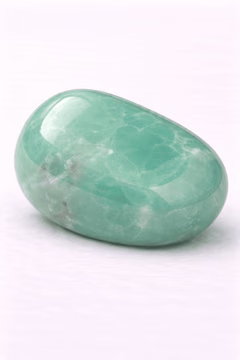
Chrysoprase is a apple green stone traditionally linked to self-love, optimism, release.
The essentials
- Family
- Chalcedony
- Composition
- SiO₂ (with Ni)
- Crystal system
- Trigonal
- Hardness (Mohs)
- 6.5–7
- Color
- Apple green
- Chakras
- Heart
- Elements
- Earth/Water
- Zodiac
- Taurus
Green from nickel, not chromium
Chrysoprase belongs to the great chalcedony family: quartz with crystals so fine the eye cannot resolve them, which gives it that soft, almost waxy surface. Its color does not come from chromium, the usual culprit in green stones, but from minute inclusions of nickel compounds trapped in the silica.
The finest deposits today are in Australia, in the Marlborough district of Queensland. Historically it was Silesia, in what is now south-western Poland, that supplied Europe; Tanzania and Kazakhstan produce it as well. Gem quality is genuinely rare, which makes chrysoprase the most valuable of the chalcedonies, well ahead of carnelian or agate.
Chrysoprase, by tradition
Chrysoprase opens out a tender apple green, fresh as a leaf in spring. Tradition ties it to gentleness toward yourself, to optimism, and to the urge to turn a page and open to renewal. Its bright, living tint calls to mind first shoots, that moment when everything quietly begins again. Wear it as jewelry or rest it over the heart during a meditation. Welcome it when you feel it’s time to let what weighed on you set off again and to offer yourself more tenderness.
Affirmation“I open to renewal.”
Prague, Prussia, and a stone of invisibility
Chrysoprase has had its princely moments. The Chapel of Saint Wenceslas in Prague, fitted out in the fourteenth century under Charles IV, is inlaid with it alongside amethysts and jaspers. Frederick the Great of Prussia was fond enough of it to set it into his palaces; Silesia, then Prussian, was full of the stuff.
Kunz, gathering mineral lore in 1913, passes on two good ones: that Alexander the Great wore a chrysoprase at his belt in battle, and that in the Middle Ages a condemned thief could escape his judges’ eyes by putting one in his mouth. A stone of invisibility, in other words, which has since become a stone of gentleness.
How to use chrysoprase
Jewelry, heart meditation.
Cleansing
A rinse, smoke, sound.
Charging
Moonlight; intention.
Common questions
- Does chrysoprase really fade in the sun?
- Yes, and it is one of its better-documented traits. The color depends on nickel but also on water held within the silica. Heat and direct light dehydrate it and the green goes out. Keep it out of full sun; that is genuinely the only care it asks for.
- Can a faded chrysoprase be brought back?
- Sometimes, partly. A spell wrapped in a damp cloth can rehydrate the silica and revive a dulled stone. It does not always work, and it will not restore a piece that has been baking on a windowsill for years, but it is worth trying before you give up on it.
- How do I recognize real chrysoprase?
- Be wary of a green that is too uniform at a price that is too kind: dyed agate is common. Natural chrysoprase shows slight variations in color, and dye tends to concentrate in the fractures, visible under a loupe. If in doubt, ask about origin: Australia and Poland are the classics.