Crystal healing · stone profile
Malachite
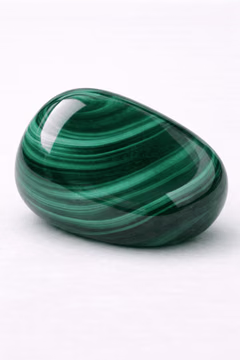
Malachite is a banded green stone traditionally linked to release, protection, confidence.
The essentials
- Family
- Copper carbonate
- Composition
- Cu₂CO₃(OH)₂
- Crystal system
- Monoclinic
- Hardness (Mohs)
- 3.5–4
- Color
- Banded green
- Chakras
- Heart
- Elements
- Earth
- Zodiac
- Scorpio
Copper, in rings like a tree
Malachite forms in the weathered upper zones of copper deposits, where water and air turn the metal slowly into a green carbonate. It grows in successive layers, the way a tree lays down rings, and that is what draws its bands and its concentric eyes. No two pieces repeat.
The name is thought to come from the Greek malakhê, mallow, whose leaves carry that green. Soft, at 3.5 to 4 on the Mohs scale, and sensitive to acids, it scratches and dulls easily. Most current production comes from the Democratic Republic of the Congo; the great historic pieces came from the Russian Urals.
Malachite, by tradition
Malachite unspools its green bands like ripples, and tradition ties it to courage in the face of change. People credit it with walking beside transformations, helping you turn a page and dare the next step, like a friend who whispers you onward. It’s a stone of the heart that many keep during meditation to stand for what they choose to leave behind. Set it near you in moments of transition, and let its deep green remind you of your quiet strength. Keep it dry and out of the sun, and welcome it above all as a symbol of renewal.
Affirmation“I move through change with courage.”
Egyptian eye paint, then the Winter Palace
Malachite is one of the oldest worked stones there is. Ground, it gave the Egyptians their green eye paint; heated, it was among the first ores from which copper was drawn. Before it was ever jewelry, it was a tool of civilization.
Its decorative moment came in the nineteenth century, when the Ural mines sent blocks large enough to satisfy the Russian court. The Malachite Room of the Winter Palace in Saint Petersburg is fitted out with columns, urns and fireplaces of it. The technique, called Russian mosaic, veneered thin slices over shaped forms so the eye would read solid stone. Kunz, meanwhile, recorded a much older habit: malachite tied to a child’s cradle to keep witches and the evil eye at a distance.
How to use malachite
Meditation (short), protected jewelry (keep from water).
Cleansing
Sound, light smoke; a dry cloth.
Charging
Moonlight; intention. Keep from sun and moisture.
Common questions
- Can you make a malachite elixir?
- No, never. The copper salts that dissolve in water are toxic, even in small amounts and even by way of a poorly sealed indirect method. This is one of the rare points where every school of crystal practice agrees with chemistry: malachite does not go in the carafe.
- Is malachite dangerous to handle?
- Polished pieces are fine to hold and wear. The caution is about dust and ingestion: wash your hands after handling rough or dusty specimens, do not sand or cut it at home, and keep it away from small children who put things in their mouths.
- How do I spot fake malachite?
- Real malachite is cold on first contact and surprisingly dense, and its banding is irregular, with imperfect eyes. Resin imitations feel light and lukewarm, and their patterns repeat too neatly. When in doubt, weight is your best clue.
- How should malachite be cleaned?
- Dry cloth, and that is it. No baths, no salt, no household products: water dulls the polish and acids attack the carbonate outright. For cleansing, tradition offers smoke or a rest on a quartz cluster; for charging, moonlight rather than full sun, which can flatten its lighter greens.