Crystal healing · stone profile
Rhodonite
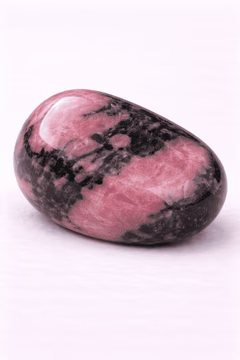
Rhodonite is a pink/red veined with black stone traditionally linked to self-love, release, calm.
The essentials
- Family
- Manganese silicate
- Composition
- MnSiO₃
- Crystal system
- Triclinic
- Hardness (Mohs)
- 5.5–6.5
- Color
- Pink/red veined with black
- Chakras
- Heart
- Elements
- Earth
- Zodiac
- Taurus
Pink from manganese, black from the same manganese
Rhodonite is a silicate whose pink comes from manganese itself, written into the formula rather than dropped in as an impurity. The black veins and dendrites that streak it are manganese oxides, formed as the stone weathered along its fissures. Its most famous flaw is, in other words, its signature.
It was described in 1819 from samples out of the Harz in Germany, but its major deposits lie elsewhere: the Russian Urals for ornamental masses, Broken Hill in Australia for the rare transparent red crystals collectors fight over, and Brazil, Peru and Madagascar for commercial material.
Rhodonite, by tradition
Rhodonite blends a warm pink with fine black veins, like a tenderness shot through with depth. Tradition ties it to compassion, to gentleness toward yourself, and to the urge to soothe the heart and let resentments drift off. Its color calls to mind a rosy dawn, intimate and comforting. Rest it over the heart during a meditation, or keep it in a pocket on more sensitive days. Welcome it when you choose kindness, for others and for yourself.
Affirmation“I choose compassion.”
Orletz, the eagle stone of the Urals
Found in the Urals in the eighteenth century near Yekaterinburg, where it was known as orletz, the eagle stone, rhodonite became one of Russia’s mineral emblems. Imperial lapidaries drew monumental vases, columns and table tops from it, and it lines the Mayakovskaya station of the Moscow metro.
Its most staggering piece is a tomb. The sarcophagus of the Empress Maria Alexandrovna, in the Peter and Paul Cathedral in Saint Petersburg, was cut from a single block of rhodonite weighing dozens of tons; the workshops spent years on it. On the other side of the world, Massachusetts made rhodonite its official gemstone in 1979.
How to use rhodonite
Heart meditation; pocket.
Cleansing
Sound, smoke; a quick rinse, then dry.
Charging
Moonlight; intention.
Common questions
- What is the difference between rhodonite and rhodochrosite?
- Same manganese, two distinct stones. Rhodochrosite is a carbonate, softer at 3.5 to 4, banded pink and white like a stick of candy. Rhodonite is a harder silicate with a denser pink, veined in black rather than white.
- Can rhodonite go in water?
- A quick rinse, yes; a long soak, no. Water does not dissolve it, but sustained damp encourages the manganese to oxidize along the fissures, which is exactly where those black veins come from. Always dry it after cleaning.
- Does rhodonite fade?
- Repeated full sun can dull the pink over time, so moonlight or soft light is the better choice for charging. Store it away from quartz and topaz, which scratch it without effort; a soft pouch suits it well.