Crystal healing · stone profile
Kyanite
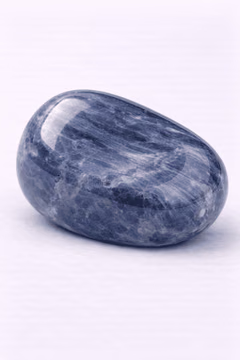
Kyanite is a blue stone traditionally linked to communication, intuition, focus.
The essentials
- Family
- Nesosilicate
- Composition
- Al₂SiO₅
- Crystal system
- Triclinic
- Hardness (Mohs)
- 4.5–7
- Color
- Blue, green, black
- Chakras
- Throat, Third eye
- Elements
- Air
- Zodiac
- Taurus
One crystal, two hardnesses
Kyanite is an aluminum silicate born under pressure in metamorphic rock: the same chemical recipe as andalusite and sillimanite, baked under different conditions. It grows as long flattened blades, blue from traces of iron and titanium, with an almost pearly luster on the cleavage faces.
Its famous quirk is a double hardness. Scratch along the length of the blade and it gives way at around 4.5; scratch across it and it holds near 7. That contrariness earned it the alternative name disthene, “two strengths” in Greek. The finest pieces come from Nepal and Brazil, with Switzerland, Austria, Kenya and the United States also producing.
Kyanite, by tradition
Kyanite stretches its blades of deep blue streaked with light, like shards of frozen water. Tradition ties it to inner alignment, to that sense of being at last in agreement with yourself, and to speech that moves freely. Its tint calls to mind the sky just before night, when thoughts settle and find their rightful place. Hold it before a meditation or a conversation you want clear and aligned. Keep it near you when you’re trying to put words to what you truly feel.
Affirmation“I am aligned and clear.”
Two names, and a second life in the furnace
Abraham Gottlob Werner named it kyanite in 1789, from the Greek kuanos, dark blue; the Frenchman René Just Haüy preferred disthene a few years later, in tribute to that double hardness. Both names survived. Cut and polished, it has spent a good deal of its career being mistaken for sapphire, whose blue it can approach.
Its second career is less romantic and rather more useful. Kyanite is a first-rate refractory: heated, it converts to mullite, which resists extreme temperatures. It goes into kiln ceramics, technical porcelain and spark plugs. The same blue blade lives in an esoteric display case and in heavy industry.
How to use kyanite
Meditation, communication.
Cleansing
Sound, smoke; avoid soaking.
Charging
Moonlight; intention.
Common questions
- Kyanite or disthene: are they the same stone?
- The same mineral under two names. Kyanite is the international term, given by Werner in 1789; disthene is the historic French name from Haüy. On a label, both point to the same blue-bladed aluminum silicate.
- Is it true that kyanite never needs cleansing?
- That is a belief from modern crystal books, which hold that the stone stores nothing. There is no way to measure it either way. If the cleansing ritual matters to you, keep it; if not, a soft dry cloth is genuinely all the stone requires.
- Can kyanite go in water?
- A quick rinse is fine, but avoid baths: water and salt work into the cleavage and weaken the blades. The real danger is mechanical anyway. Kyanite has perfect cleavage, and a knock splits it lengthwise into thin sheets.
- Why do some kyanite blades scratch so easily?
- Because you are scratching along the blade rather than across it. In that direction it sits near 4.5 on the Mohs scale, soft enough for a steel point to mark. Turn ninety degrees and the same crystal resists almost like quartz. Very few minerals behave this way.