Crystal healing · stone profile
Howlite
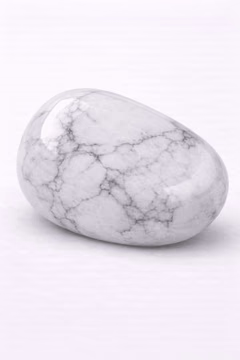
Howlite is a white with gray veining stone traditionally linked to calm, release, focus.
The essentials
- Family
- Borate
- Composition
- Ca₂B₅SiO₉(OH)₅
- Crystal system
- Monoclinic
- Hardness (Mohs)
- 3.5
- Color
- White with gray veining
- Chakras
- Crown
- Elements
- Air
- Zodiac
- Gemini
A Canadian discovery, and a very thirsty stone
Howlite is young in the literature. In 1868 the chemist and mineralogist Henry How described it in the gypsum quarries of Nova Scotia, where the miners considered it a nuisance; the great American mineralogist James Dana later named it in his honor. It also turns up in California, Turkey and Mexico.
It grows in rounded nodules that look rather like cauliflowers, matte white and run through with gray or blackish veins. At hardness 3.5 a knife point marks it. It is soft, porous and noticeably light in the hand, which alone tells it apart from white marble or quartz.
Howlite, by tradition
Howlite is a stone of slowed breath, white veined with gray like a soothed sky. Tradition links it to calm, to letting go, to that way of coming back to yourself when the mind spins too fast. Its smooth surface makes it a soft pebble to hold, to brush with your thumb in the moments you’re trying to settle. Keep it by the bed or in a pocket for the end of the day, when you want to release the tension you’ve carried. Set it in your palm and breathe slowly, long enough to let the quiet settle in.
Affirmation“I slow down and breathe.”
The understudy that plays turquoise
That porosity made its commercial fortune, not always to its credit: howlite drinks dye like a sponge. Stained blue, veins and all, it passes for turquoise convincingly enough, and it is sold under the invented name turquenite, which corresponds to no mineral at all.
A few markers keep you honest. An oddly low price on “turquoise,” a color that is too even, a surface that scratches easily. A cotton pad with acetone that comes away blue settles it. There is nothing shameful about wearing dyed howlite, as long as it was sold to you for what it is.
How to use howlite
Evening, a pause; a touch/worry stone.
Cleansing
Sound, smoke; a quick rinse, then dry (it’s porous).
Charging
Moonlight; intention.
Common questions
- Howlite or turquoise: how do I tell them apart?
- Price first: good natural turquoise is expensive, howlite is not. Hardness next: howlite gives way to a knife point, turquoise holds up better. And an acetone swab on an inconspicuous spot will reveal the dye on a howlite that has been turned blue.
- Can howlite go in water?
- No. This is the textbook stone not to soak. It is porous, it absorbs water, and dyed pieces bleed their color at the first bath. Salt is worse, because it works its way in and crystallizes inside the stone. Smoke or a rest on a quartz cluster is the way to cleanse it.
- Is white howlite dyed too?
- No, white is its natural color, a matte chalky white webbed with gray veins. The dye is what turns it blue for the turquoise imitation, or occasionally other colors. If you want howlite as howlite, buy it white.
- Does howlite help with sleep?
- Tradition puts it on the nightstand or under the pillow, and reads its veined whiteness as a calm sky crossed by a few thoughts that pass without settling. No measurable effect has ever been found beyond placebo, Christopher French’s 2001 test included. What helps is the ritual of the evening, and the stone marking it.