Crystal healing · stone profile
Fluorite
Fluorite is a multicolored (green stone traditionally linked to focus, calm, intuition.
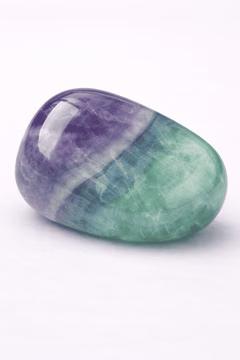
The essentials
- Family
- Halide
- Composition
- CaF₂
- Crystal system
- Cubic
- Hardness (Mohs)
- 4
- Color
- Multicolored (green, violet, blue…)
- Chakras
- Third eye
- Elements
- Air
- Zodiac
- Capricorn, Pisces
Cubes that look cut, and were not
Fluorite crystallizes in the cubic system, and it does so with a precision that startles people: specimens come out of the ground as cubes so clean they look like they went through a workshop. The name comes from the Latin fluere, to flow, because metallurgists used it as a flux to loosen up ores. It also gave us a word. Watching its glow under certain light, the physicist George Stokes coined fluorescence in 1852.
Its colors, among the most varied in the mineral world, come from rare-earth impurities and defects in the lattice, some of them created by natural irradiation from the neighboring rock. Hence the spectacular zoning, violet over green over blue inside a single crystal. China, Mexico, South Africa and England lead production. France had beautiful mines too, in the Tarn among others, now closed.
Fluorite, by tradition
Fluorite plays with every color, from tender green to violet by way of blue, and tradition ties it to a clear, well-ordered mind. People credit it with the art of putting the mind back in order when thoughts scatter every which way, like an inner library finding its shelves again. It’s a stone many like to keep close to study, to organize an idea, or to pick up the thread. Set it on your desk on the days you need a soft kind of focus, and let its intention invite you to breathe before getting back to work. Symbolically, it goes with sorting things out and a calm clarity.
Affirmation“I keep my mind clear and organized.”
Blue John, and a Roman argument that never ended
The most famous fluorite is English. Blue John, banded in violet and yellow, is mined only near the village of Castleton in Derbyshire. In the eighteenth century it was turned on lathes into vases and bowls for the great British houses; Chatsworth still keeps superb pieces of it.
Some historians of gems go further and read Blue John as the material of the murrhine vessels Pliny the Elder described as the most precious things in Rome, bought by patricians for fortunes. The identification is still argued over. What it tells you is how long these impossible layered colors have held people’s attention.
How to use fluorite
Desk, study; avoid knocks.
Cleansing
Sound, smoke; avoid salt; a very quick rinse, then dry.
Charging
Moonlight; a cluster; avoid long full sun (it can fade).
Common questions
- Fluorite or fluorspar: which is right?
- Both name the same mineral. Fluorite is the standard mineralogical term in English; fluorspar is the older industrial name, still used in mining and metallurgy for the bulk material. On a specimen label you will see fluorite.
- Why does my fluorite have several colors?
- That is its signature. The bands record separate growth episodes, each with its own impurities and conditions. A crystal that runs violet into green has not been dyed or glued together; it simply had several lives while it was growing.
- How fragile is fluorite?
- More than most people expect. At hardness 4 it defines that step on the Mohs scale, a knife blade marks it, and it cleaves cleanly on a knock. Store it away from quartz and garnet, which will scratch it without trying, and handle it like fine glassware.
- Does fluorite help you concentrate?
- Tradition puts it on the desk during study, and reads its layered colors as a picture of a mind putting things back in order. No study has shown any crystal effect beyond placebo; Christopher French ran the test in 2001 with real crystals and indistinguishable glass copies, and the reported sensations matched. The stone does not do the work. It reminds you of the work you chose.