Crystal healing · stone profile
Lapis Lazuli
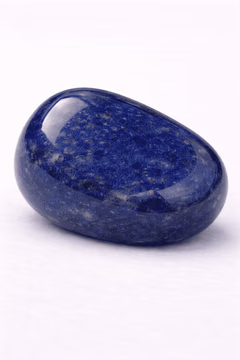
Lapis Lazuli is a deep blue stone traditionally linked to communication, intuition, confidence.
The essentials
- Family
- Rock (lazurite, calcite, pyrite)
- Composition
- Rock; main component lazurite
- Crystal system
- Variable
- Hardness (Mohs)
- 5–5.5
- Color
- Deep blue, golden flecks
- Chakras
- Throat, Third eye
- Elements
- Air
- Zodiac
- Sagittarius
A rock pretending to be a mineral
Unlike most stones in this collection, lapis lazuli is a rock: a mixture whose main ingredient is lazurite, which owes its deep blue to clusters of sulfur trapped in its structure. Calcite draws the white veins through it, and pyrite scatters the golden specks that make people think of a night sky.
The historic deposit is Sar-e-Sang, in Afghan Badakhshan, worked for more than six thousand years: the oldest mine still in operation anywhere. Lapis is also mined in Chile and near Lake Baikal in Russia. The most sought-after pieces show a dense blue, little calcite, and pyrite in a fine scatter rather than in patches.
Lapis Lazuli, by tradition
Lapis lazuli wears a deep blue scattered with golden flecks, like a small night sky, and tradition ties it to true speech. People credit it with helping you express yourself with authenticity, to say things as you feel them without detour, like a voice finding its footing again. It’s a stone many keep before an important conversation to stand for their intention to speak truly. Hold it in your hand or set it in front of you before an exchange you care about, and let its blue invite you to clarity. Symbolically, it goes with sincere communication and inner listening.
Affirmation“I speak with authenticity.”
From Tutankhamun’s mask to Vermeer’s turban
Lapis runs through the whole of ancient history: the eyes of Sumerian statues, the Standard of Ur, the eyebrows on Tutankhamun’s funerary mask. Pliny the Elder described, under the name sapphirus, a blue stone sown with points of gold. Almost certainly our lapis, and not the modern sapphire at all.
Ground and purified it becomes ultramarine, the most precious pigment in European painting. In the Renaissance it traded above gold by weight and was reserved for the Virgin’s mantle or for the one sky in a picture that had to carry everything. The turban in Vermeer’s Girl with a Pearl Earring owes its glow to this Afghan blue.
How to use lapis lazuli
Before an important conversation; meditation.
Cleansing
Sound, smoke; a dry cloth.
Charging
Moonlight; intention.
Common questions
- How do I recognize real lapis lazuli?
- Look for pyrite: fine, irregular golden flecks are a good sign. The common imitations are dyed howlite or jasper, too evenly blue, with no gold and no natural veining. An unusually low price on a very blue, very uniform stone should raise an eyebrow.
- Can lapis lazuli go in water?
- Brief contact will not destroy it, but avoid soaking. The rock is porous, the calcite dissolves slowly and the pyrite can oxidize. Salt is worse still. A soft cloth for cleaning, and smoke for cleansing if you want to keep the ritual.
- Does perfume damage lapis?
- It does, and this is the practical rule worth remembering: put your lapis on after the perfume, never before. Alcohol and household products dull the polish of a porous rock and can attack the pyrite. Same logic for hand cream and hairspray.
- Why is lapis lazuli so expensive?
- Because the good material is genuinely scarce. Dense blue with little calcite comes from a small number of Afghan workings, transport has never been simple, and the market prices color and evenness sharply. Paler, heavily veined pieces are affordable; the deep even blue never has been.