Crystal healing · stone profile
Angelite (Anhydrite)
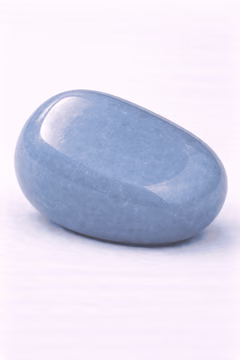
Angelite is a pale blue stone traditionally linked to calm, intuition, communication.
The essentials
- Family
- Sulfate (anhydrite)
- Composition
- CaSO₄
- Crystal system
- Orthorhombic
- Hardness (Mohs)
- 3–3.5
- Color
- Pale blue
- Chakras
- Throat
- Elements
- Air
- Zodiac
- Aquarius
Gypsum with the water taken out
Under its shop name, angelite is anhydrite: a calcium sulfate that formed without a drop of water in its structure. It is the dry sister of gypsum, and that kinship is not a detail. In prolonged contact with water, anhydrite slowly takes the water back and turns into gypsum, which dulls its surface irreversibly.
Its soft, almost chalky blue varies from block to block and is often crossed by white veins. Nearly every piece on the market comes from the Caravelí region in southern Peru; anhydrite occurs in Mexico, Germany and Poland as well, but rarely in that blue. At hardness 3 to 3.5, a simple knife point marks it.
Angelite, by tradition
Angelite offers a milky pale blue, soft and restful like a hazy late-afternoon sky. Tradition ties it to serenity, to intuition, and to speech that settles with delicacy. Its tender color calls to mind the soothing quiet of a calm corner, away from the noise. Keep it in your meditation space, or hold it before an exchange you want to keep gentle. Welcome it when you’re trying to express yourself calmly and reconnect with your own quiet.
Affirmation“I communicate with gentleness.”
An old mineral with a very new name
The mineral itself has a long and well-documented pedigree: the geologist Abraham Gottlob Werner named anhydrite in 1804, from the Greek anhydros, without water. The name angelite, on the other hand, appears around 1987, when the Peruvian deposit reached the mineral market. The year is not incidental. It is the year of the Harmonic Convergence, a high point of the New Age movement, and the angelic christening rode that wave.
It makes an instructive case: a stone can enter tradition within a single generation. Descriptions that credit angelite with ancestral uses are confusing the mineral, long familiar to quarrymen and plasterers, with its commercial persona, which is a few decades old.
How to use angelite
Meditation; a quiet corner.
Cleansing
Sound, smoke; a dry cloth.
Charging
Moonlight; intention.
Common questions
- Can angelite go in water?
- No. Anhydrite takes up water on contact and slowly converts to gypsum: the surface dulls, whitens and does not come back. Dry cleaning only, with a soft cloth, and cleansing by smoke if you want to keep the ritual.
- Are angelite and celestite the same stone?
- No, though their blues do resemble each other. Angelite is a calcium sulfate (anhydrite), celestite a strontium sulfate. The mix-up is common in shops; celestite comes mostly as geodes bristling with crystals, angelite as opaque polished stones.
- Is angelite an ancient stone?
- The mineral is old and well documented; the name and the symbolism are not. Anhydrite was named in 1804, but angelite as a crystal-shop stone dates from the late 1980s. Knowing that does not diminish it. It just puts the story on the right shelf.
- How should I store angelite?
- Apart from everything else. At 3 to 3.5 it is soft enough that a single rub against a quartz tumble will scratch it, and knocks chip it. A soft pouch of its own, away from damp, and moonlight rather than full sun for charging.