Crystal healing · stone profile
Hematite
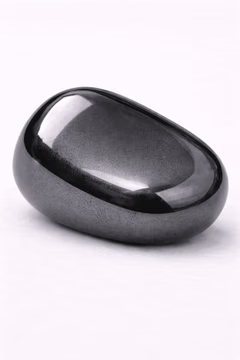
Hematite is a metallic gray stone traditionally linked to grounding, focus, confidence.
The essentials
- Family
- Iron oxide
- Composition
- Fe₂O₃
- Crystal system
- Trigonal
- Hardness (Mohs)
- 5–6
- Color
- Metallic gray, black
- Chakras
- Root
- Elements
- Earth
- Zodiac
- Aries
The iron that marks red
Hematite is the planet’s main iron ore, an oxide that takes a dark metallic polish. Its best-known paradox is one gesture away: drag it across unglazed ceramic and the streak comes up blood red, not gray. That red is what earned it the Greek haima, blood.
It is mined on a huge scale in Brazil’s Minas Gerais, in Australia and in China; Elba supplied the Etruscans. It has also left the planet. In 2004 the Opportunity rover photographed hematite spherules on Mars, nicknamed blueberries, among the first solid clues that water once stood there. The red of Mars is, in large part, this mineral.
Hematite, by tradition
Hematite has that dense, smooth metallic-gray shine, and tradition ties it to stability and grounding. People credit it with drawing your attention back to the ground, like a small bit of ballast you keep on you to feel steadier and more focused. It’s a stone many appreciate at work or in stretches when you have to hold your course without scattering. Slip it into a pocket or wear it on your wrist when you want to stand for your will to stay centered and steady. Its quiet weight invites presence and an inner footing.
Affirmation“I am stable and focused.”
Cave ocher, mummy amulets, invulnerable soldiers
Hematite has been with us since our first attempts at making images. Ground down it gives the red ocher that covers the walls of Paleolithic painted caves, and it shows up in burials of extraordinary age, among them Blombos Cave, more than seventy thousand years old. Much later the Egyptians cut it into amulets tucked among mummy wrappings, and Roman engravers made intaglios from it.
Kunz, in 1913, recorded the belief that stuck hardest: ancient warriors rubbed hematite powder over their bodies before battle, convinced the blood stone made them proof against wounds. The reasoning was perfectly clear for the time. A stone that bleeds red must have some business with the blood of men.
How to use hematite
At work, in a pocket, a bracelet.
Cleansing
Sound, smoke; avoid soaking (it can oxidize).
Charging
The earth, moonlight; intention.
Common questions
- My hematite sticks to a magnet. Is it real?
- Probably not. Natural hematite is only very weakly magnetic. Strongly magnetic beads are synthetic ferrite, sold as hematine or “magnetic hematite.” The streak test stays the most reliable check: real hematite leaves a red mark on unglazed ceramic.
- Can hematite go in water?
- Briefly, yes; a quick rinse does no harm. But it is an iron oxide, and long or salty soaks can dull fractured or poorly polished areas. Tradition prefers dry cleansing for it anyway, smoke or a short spell in earth, which suits it better.
- Why does hematite feel so heavy?
- Because it is iron. Its density is far above that of quartz, and that unexpected weight in the palm is a large part of what people respond to. Tradition reads it as the stone of coming back down into the body, and the weight is doing most of the persuading.
- Does hematite ground you?
- That is what the tradition reads into it, and no study has shown any crystal effect beyond placebo, per Christopher French in 2001. What is real is the gesture: closing your hand around something dense and cool when your thoughts are circling. The stone is the cue, not the cause.