Crystal healing · stone profile
Sodalite
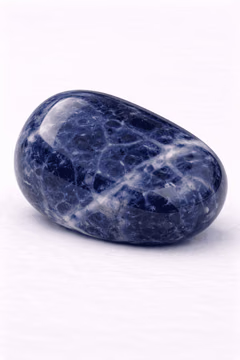
Sodalite is a blue stone traditionally linked to focus, communication, intuition.
The essentials
- Family
- Tectosilicate
- Composition
- Na₈(Al₆Si₆O₂₄)Cl₂
- Crystal system
- Cubic
- Hardness (Mohs)
- 5.5–6
- Color
- Blue, white
- Chakras
- Throat, Third eye
- Elements
- Air
- Zodiac
- Sagittarius
The blue that grows where quartz cannot
Sodalite is a feldspathoid: a cousin of the feldspars that crystallizes in silica-poor magmas, in conditions where quartz simply cannot form. Its name, given in 1811 from Greenland samples, comes straight from the sodium it holds in abundance, with a touch of chlorine. The deep blue comes from sulfur ions caught in the cages of its structure, absorbing the warm end of the spectrum and letting only blue through.
The white veins running through it are usually calcite, and their pattern is what makes each piece recognizable. Major deposits are in Brazil (Bahia), Canada (Bancroft, Ontario), Greenland, Namibia and Bolivia. One rare variety, hackmanite, changes color under ultraviolet and then returns to its original tone in the dark, a behavior mineralogists call tenebrescence.
Sodalite, by tradition
Sodalite blends deep blue and white in quiet veins, a hue that tradition ties to the throat and the third eye, to clarity of mind. People link it to ordered thinking, to apt expression, to the ability to put clear words on what you feel. Its color calls to mind a serene night sky, good for reflection. Keep it on your work surface or your desk during study and focus. Set it near you when you want to lay out your ideas calmly, without scattering.
Affirmation“I think clearly and I express myself.”
Princess Blue
Unlike lapis lazuli, ground into pigment and carved since antiquity, sodalite is a young stone. Described in 1811, it stayed a collector’s curiosity until the great Ontario deposits at Bancroft were found toward the end of the nineteenth century. Its symbolism is recent, and saying so is simply honest.
Its moment came in 1901. During a royal visit to Canada, the future Queen Mary noticed Bancroft sodalite and had several tons shipped to London to decorate Marlborough House. The stone picked up the nickname Princess Blue, which Canadian lapidaries still use.
How to use sodalite
Study, work; a short meditation.
Cleansing
Sound, smoke; a quick rinse, then dry.
Charging
Moonlight; intention.
Common questions
- Sodalite or lapis lazuli: how do I tell them apart?
- Look at the inclusions. Lapis almost always carries golden flecks of pyrite; sodalite has none. Its blue runs more toward ink, its white veining is broader, and its price is much gentler. The two are relatives, though: the lazurite in lapis belongs to the same mineral group as sodalite.
- Can sodalite go in water?
- A quick rinse in clear water, yes. A long soak, no: its moderate hardness and its calcite veining do not appreciate it. Salt water is out entirely, since it attacks the polish.
- What is hackmanite?
- A rare variety of sodalite that is tenebrescent: expose it to ultraviolet and the color deepens or shifts, then fades back in darkness. It is one of the few color changes you can watch happen in real time, and it is also why hackmanite should be kept out of prolonged sunlight.