Crystal healing · stone profile
Prehnite
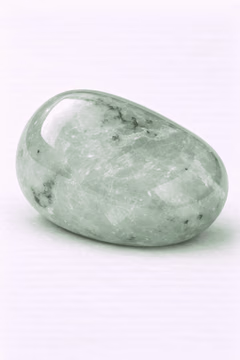
Prehnite is a pale green stone traditionally linked to calm, intuition, release.
The essentials
- Family
- Phyllosilicate
- Composition
- Ca₂Al(AlSi₃O₁₀)(OH)₂
- Crystal system
- Orthorhombic
- Hardness (Mohs)
- 6–6.5
- Color
- Pale green
- Chakras
- Heart, Plexus
- Elements
- Earth
- Zodiac
- Libra
Green grapes, in stone
Prehnite is a calcium aluminum silicate that rarely bothers with well-formed single crystals. It turns up instead in rounded botryoidal masses, like green grapes fused together. The color, pale green to yellow-green, comes from traces of iron; the milky, almost waxy translucency is what makes people pick it up.
It forms in cavities in volcanic rock, in good company: zeolites, epidote, sometimes native copper. Those dark green or black needles caught inside certain pieces are epidote, and collectors chase them. Notable deposits are in Mali, Australia, South Africa, China and Scotland; France has produced it too, in the Alps.
Prehnite, by tradition
Prehnite has the pale green tint of morning dew, translucent and restful. Tradition ties it to inner calm, to intuition, and to the knack for sorting things out with kindness, without being hard on yourself. Its soft color calls to mind a garden at waking, when the air is still cool and quiet. Hold it during a meditation or set it near you as you write out your thoughts. Keep it close when you want to see more clearly while staying gentle with yourself.
Affirmation“I sort things out with kindness.”
The first mineral named after a person
Prehnite has an unusual entry in the register: it is the first mineral in history to be named after a person. The Dutch colonel Hendrik von Prehn brought samples back from the Cape of Good Hope, and Abraham Gottlob Werner described and named it at the end of the 1780s. Before that, stones were named for places, colors or gods. Afterward, mineralogists stopped holding back.
The honest consequence is that prehnite has no two thousand years of legend behind it. No ancient amulet, no medieval talisman. The associations it carries date essentially from contemporary crystal practice. It is a young tradition, and saying so is part of the respect it is owed.
How to use prehnite
Meditation, journaling.
Cleansing
Smoke, sound; a quick rinse, then dry.
Charging
Moonlight; intention.
Common questions
- Is prehnite an ancient stone?
- The mineral is; its tradition is not. Described in the late eighteenth century, it appears in no ancient or medieval lapidary, and its symbolic associations come from modern crystal practice. That has not stopped it finding a place, but it is worth knowing which is which.
- What is the difference between prehnite and jade?
- They are easily confused by eye. Jade, whether jadeite or nephrite, is opaque to faintly translucent and considerably tougher; prehnite has that characteristic milky translucency, like a green honey drop, and often shows dark epidote inclusions that jade does not.
- How should prehnite be cared for?
- At 6 to 6.5 it takes a rinse in clear water, or mild soapy water for jewelry; just dry it afterward. Prefer moonlight or soft morning light for charging, since prolonged full sun can wash out a green that is already tender. Store it away from quartz and other harder stones.