Crystal healing · stone profile
Aquamarine
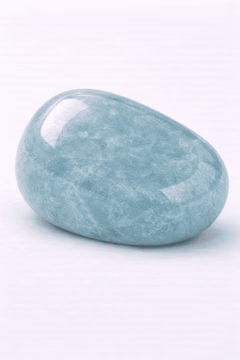
Aquamarine is a light blue stone traditionally linked to communication, calm, confidence.
The essentials
- Family
- Beryl
- Composition
- Be₃Al₂Si₆O₁₈
- Crystal system
- Hexagonal
- Hardness (Mohs)
- 7.5–8
- Color
- Light blue
- Chakras
- Throat
- Elements
- Water
- Zodiac
- Pisces
Emerald’s sibling, in a different mood
Aquamarine is beryl, a beryllium aluminum silicate, exactly like emerald. Only the trace of color changes. Here it is iron that pulls the crystal toward blue, where chromium makes the emerald green and manganese makes morganite pink. Same house, three tempers.
It grows in hexagonal prisms that can become spectacular: the Dom Pedro, cut as an obelisk from a Brazilian crystal, tops ten thousand carats and stands at the Smithsonian. The major deposits are in Brazil’s Minas Gerais, in Pakistan, Madagascar and Nigeria. Worth knowing: much of the material on the market is heated to clear a greenish cast, a stable treatment accepted for a long time.
Aquamarine, by tradition
Aquamarine carries the clear tint of still waters, a transparent blue that tradition ties to the throat and to serene speech. People link it to a settled way of expressing yourself, to saying things without rushing, from a calmed place within. Its color calls to mind the quiet sea at first light, fluid and limpid. Wear it as jewelry or keep it near before speaking up or giving a presentation. Hold it for a moment and picture your words flowing softly, clear and without snag.
Affirmation“I speak with serenity.”
A sailor’s talisman, and a birthstone invented in 1912
The Romans knew it well; Pliny the Elder was already praising the beryls “that imitate the sea.” Sailors carried it as a pledge of calm water and a safe return, and it was sometimes engraved with Neptune’s likeness to multiply its power. Kunz, in The Curious Lore of Precious Stones (1913), reports that it was called the treasure of the mermaids, gathered from their sunken caskets, and credited with keeping seafarers safe.
Its place as the birthstone for March, on the other hand, is thoroughly modern: it comes from the list drawn up by American jewelers in 1912. Some of the sturdiest-looking traditions have surprisingly recent ancestors, and this one is barely a century old.
How to use aquamarine
Jewelry, before a presentation.
Cleansing
A rinse, smoke, sound.
Charging
Moonlight; intention.
Common questions
- Can aquamarine go in water?
- Yes, and it is one of the safest stones for it, hard and chemically stable. Clear water, mild soapy water, both are fine for jewelry. Just avoid violent temperature swings, and skip ultrasonic cleaners if the stone has visible inclusions.
- Is aquamarine usually heated?
- Very often. Gentle heating removes a greenish cast and leaves a purer blue, and the result is permanent and long accepted in the trade. It is not a deception, and it does not make the stone less real; it is simply something a good seller mentions.
- Why is aquamarine the March birthstone?
- Because the modern birthstone list, set by American jewelers in 1912, put it there, probably echoing its old association with the sea and with the sign of Pisces that opens the month. It is a commercial convention that became a tradition, not an inheritance from antiquity.
- How should I store aquamarine?
- Away from topaz and sapphire, which are the few things hard enough to scratch it. Its blue is discreet by nature, so prefer moonlight or early morning light for charging rather than long spells in full sun, which can wash it out further.