Crystal healing · stone profile
Apatite
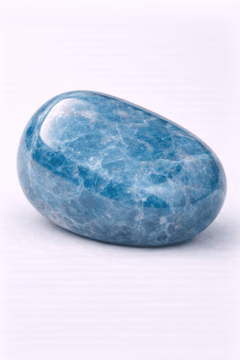
Apatite is a blue/green stone traditionally linked to focus, creativity, communication.
The essentials
- Family
- Phosphate
- Composition
- Ca₅(PO₄)₃(F,Cl,OH)
- Crystal system
- Hexagonal
- Hardness (Mohs)
- 5
- Color
- Blue/green
- Chakras
- Throat
- Elements
- Air
- Zodiac
- Gemini
You are carrying some right now
Apatite is not one mineral but a small group of calcium phosphates, of which fluorapatite is the most widespread. Friedrich Mohs picked it as the standard for step 5 of his hardness scale: anything that scratches apatite is harder, anything apatite scratches is softer. A reference stone, in the most literal sense.
You are also carrying it around permanently. The enamel of your teeth and the mineral framework of your bones are hydroxyapatite, a form of the same family. As for deposits, gem apatite comes above all from Madagascar for the famous neon blue, and also from Brazil, Mexico and Myanmar. The rest, far less glamorous, goes into fertilizer: apatite is the world’s leading source of agricultural phosphorus.
Apatite, by tradition
Apatite opens out a luminous blue-green that calls to mind a lagoon run through with light. Tradition ties it to clarity of mind, to creative drive, and to the urge to turn your ideas into concrete steps. Its bright, limpid tint wakes up curiosity, like clear water where everything becomes visible. Set it on a desk or a workspace, where projects take shape. Keep it near you when you want to give structure to your wishes and get moving with enthusiasm.
Affirmation“I turn my ideas into action.”
Why it is called “the deceiver”
Abraham Gottlob Werner named it in 1786, from the Greek apatan, to deceive. The reason is honest enough: for centuries apatites circulated under false names, taken for beryl, olivine or tourmaline, because their colors imitate everyone else’s. The name is a mineralogist’s confession.
The anecdote says something true. Before modern chemistry, a stone was judged by eye, and the eye was often wrong. Apatite carries in its name the birth of a science that learned to look past color, which is a strange fate for a stone now valued mostly for its color.
How to use apatite
Desk, creative work.
Cleansing
Sound, smoke; a quick rinse, then dry.
Charging
Moonlight; intention.
Common questions
- How do I recognize real apatite?
- By eye, that is exactly the trap that gave it its name. The neon blue from Madagascar is very distinctive, but hardness is the honest check: at 5 on the Mohs scale a steel point marks it, where the beryl or tourmaline it gets mistaken for will not give way at all. Past that, only a gemologist really settles it. Be wary of prices that are too good on very saturated stones.
- Can apatite go in water?
- Briefly, yes: a rinse in clear water does no damage. Avoid long soaks, salt water and abrasive cleaners, and dry it afterward. Its fragility is mostly mechanical anyway; scratches and knocks are what threaten it.
- Why does apatite scratch so easily?
- At hardness 5 it sits below quartz, and quartz is everywhere, including in ordinary household dust. Store it alone or in a pouch, wipe rather than rub, and prefer it as a pendant over a ring, which takes far more abuse.
- Is blue apatite heated?
- Often. Gentle heating brightens the blue, and the treatment is common in the trade. It is one more reason to keep it out of prolonged sunlight, which can pale the color again over time.