Crystal healing · stone profile
Orange Calcite
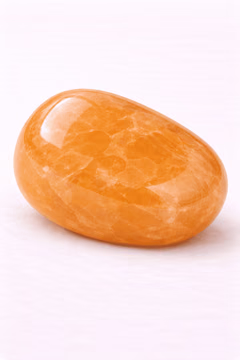
Orange Calcite is a orange stone traditionally linked to energy, optimism, creativity.
The essentials
- Family
- Carbonate
- Composition
- CaCO₃
- Crystal system
- Trigonal
- Hardness (Mohs)
- 3
- Color
- Orange
- Chakras
- Sacral, Plexus
- Elements
- Fire
- Zodiac
- Cancer
The same chemistry as chalk and marble
Calcite is calcium carbonate, the same chemistry as chalk, marble and an oyster shell. It is one of the most common minerals on the planet and one of the most playful: hundreds of crystal forms have been described. The orange version owes its color to fine traces of iron oxides, with manganese sometimes in the mix; the denser they are, the warmer the orange runs.
Almost all the pieces in shops come from Mexico, where it is quarried in large milky blocks and then cut into pebbles and spheres. A family test: calcite fizzes on contact with a drop of vinegar, the signature of a carbonate. It is also the mineral of double refraction, the effect that doubles a line of text read through a clear crystal of Iceland spar, its colorless cousin.
Orange Calcite, by tradition
Orange calcite carries the warmth of ripe fruit and the frankness of a sunny morning. Tradition ties it to creative drive, to enthusiasm and that joyful urge to get moving. Its round, luminous color wakes you gently, like a lamp switched on at daybreak. Set it on a desk or a corner of a workshop, where ideas come to life. Rest your eyes on it when you want to find the pleasure of creating again and set off lightly.
Affirmation“I create with enthusiasm.”
Lime kilns, and a Viking navigation puzzle
Its name comes from the Latin calx, lime: calcite has been the raw material of lime kilns since antiquity, and therefore of whole stretches of human building, from limestone pyramids to frescoes painted on lime plaster. Few minerals have kept us this close company.
Its transparent cousin, Iceland spar, carries a fascinating claim: that it was the sunstone of Viking navigators. Researchers have shown that a crystal of this kind really can recover the sun’s position under an overcast sky, through the polarization of light. The hypothesis is still argued over, but it says something about where this mineral family sits in the imagination. A stone that helps you find your bearings.
How to use orange calcite
A creative desk; morning.
Cleansing
Sound, smoke; a dry cloth.
Charging
Moonlight; intention; avoid water/salt.
Common questions
- Can orange calcite go in water?
- Briefly, yes; a quick rinse does nothing to it. Avoid long soaks, which dull the surface, and keep it away from anything acidic, even something as mild as vinegar: calcium carbonate fizzes in acid and dissolves.
- Why has my orange calcite gone pale?
- Most likely the sun. Long, repeated exposure to direct light washes out the color, much as it does with amethyst. Keep it off south-facing sills and charge it by moonlight instead.
- How soft is calcite?
- Soft enough to matter: 3 on the Mohs scale, which a knife point scratches without effort. Almost everything else in your collection can mark it, so store it on its own or in a soft pouch, and handle spheres with two hands.