Crystal healing · stone profile
Moonstone
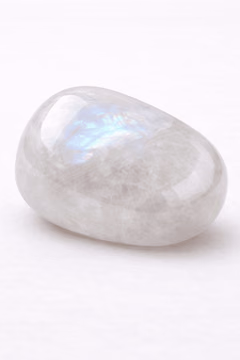
Moonstone is a white stone traditionally linked to intuition, calm, self-love.
The essentials
- Family
- Feldspar (orthoclase)
- Composition
- KAlSi₃O₈ (often orthoclase)
- Crystal system
- Monoclinic
- Hardness (Mohs)
- 6–6.5
- Color
- White, cream, bluish sheen
- Chakras
- Sacral, Crown
- Elements
- Water
- Zodiac
- Cancer, Pisces
A glow that floats under the surface
Moonstone is a variety of orthoclase, a potassium feldspar, and its secret is structural. As the crystal cooled it separated into alternating layers of two feldspars, so thin that they scatter light rather than transmitting it cleanly. That is adularescence: the bluish or silvery veil that drifts across the stone as you tilt it, always seeming to sit a little below the polished face.
Its other name, adularia, comes from the Adula massif in the Swiss Alps where the mineral was described. The finest stones, blue sheen over a nearly transparent body, come from Sri Lanka; India, Madagascar and Burma produce it too, more often in peach, gray and cream tones.
Moonstone, by tradition
Moonstone has a milky sheen that seems to hold a little moonlight, and tradition ties it to the feminine, to cycles, and to the emotions you learn to welcome. People credit it with a soft presence that invites you to honor your own rhythm rather than force it, the way the moon never rushes to change its phase. It’s a stone many keep for evening rituals, when it’s time to slow down and listen to your inner tides. Hold it in your hand on the nights you feel raw, and let its intention remind you that everything passes and returns. Symbolically, it goes with intuition and tenderness toward yourself.
Affirmation“I honor my own rhythm and my emotions.”
Pliny, India, and the Art Nouveau revival
Pliny the Elder already wrote that the stone held an image of the moon inside it, and that its brightness grew and faded with hers. Wrong, but forgivable: the sheen looks alive. Kunz recorded in 1913 that in India it was held sacred, carried as a lucky stone by lovers and credited with bringing good dreams.
At the turn of the twentieth century Art Nouveau gave it a second life. René Lalique and his contemporaries set it everywhere, drawn to a light that seems to breathe. It remains the birthstone for June, sharing the month with pearl, a pairing that says something about the kind of luster people wanted from it.
How to use moonstone
Meditation, an evening ritual, jewelry.
Cleansing
Smoke, sound; a quick rinse, then dry.
Charging
Moonlight (ideally), intention.
Common questions
- Does moonstone change with the moon phases?
- No. Adularescence depends on the angle of the light and on how the stone was cut, not on the sky. Pliny was already telling that story two thousand years ago, and it was already a legend then. The glow moves when you move, which is a decent metaphor to settle for.
- Is rainbow moonstone real moonstone?
- Not strictly. What the trade calls rainbow moonstone is a white labradorite, a cousin in the same feldspar family, whose sheen plays in blues and multicolored flashes. It is not a serious deception, but mineralogically they are two different stones.
- Can moonstone go in water?
- A quick rinse, yes. Long soaks achieve nothing, and the real risk is mechanical: its cleavage planes make it vulnerable to knocks and to ultrasonic cleaners at the jeweler’s. Treat it as a delicate object rather than a pebble, and it will keep its glow for decades.
- What is moonstone associated with?
- Cycles, unsurprisingly. Tradition ties it to the inner tides, to what waxes and wanes quietly, to transitions and to beginnings you welcome rather than force. It also carries a long reputation as the stone of lovers and dreamers, slipped under a pillow for nights that have more to say.