Crystal healing · stone profile
Jade (nephrite/jadeite)
Jade is a green (various) stone traditionally linked to grounding, self-love, optimism.
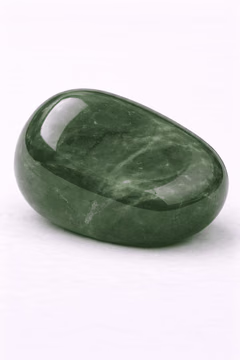
The essentials
- Family
- Silicate (gem rock)
- Composition
- Nephrite: Ca₂(Mg,Fe)₅Si₈O₂₂(OH)₂ / Jadeite: NaAlSi₂O₆
- Crystal system
- Variable
- Hardness (Mohs)
- 6–7
- Color
- Green (various), white
- Chakras
- Heart
- Elements
- Earth
- Zodiac
- Libra
Two minerals, one word
For thousands of years people carved “jade” without knowing there were two of them. Alexis Damour settled it in 1863: jadeite is a pyroxene rich in sodium and aluminum, nephrite an amphibole from the tremolite-actinolite series. Two chemistries, two origins, one name, and very similar virtues in the hand.
What they share is what made their reputation: extraordinary toughness. Nephrite’s interlocking mineral fibers make it one of the hardest stones in the world to break, which is why the Neolithic made axes and blades from it. Gem jadeite comes mainly from Burma, around Hpakant, and from Guatemala; nephrite from Hotan in China, from New Zealand, British Columbia and Siberia. Imperial green owes its fire to chromium.
Jade, by tradition
Jade is a stone of harmony and quiet balance, revered for a long time across many traditions. People link it to the heart, to a soft grounding, to the serenity that goes with intentions set with care. Its deep green calls to mind peaceful nature, slow growth, and the living world that lasts. Keep it at home or as jewelry, like a companion to your rituals of intention. Hold it in your hand as you name a wish, and let its calm help you cultivate peace.
Affirmation“I cultivate harmony.”
Worth more than gold, on two continents
The word itself is a fossilized belief. The conquistadors called it piedra de ijada, stone of the flanks, because they credited it with easing pain in the kidneys; nephrite comes from the Greek nephros, kidney, for the same reason. Science kept nothing of the belief, and the dictionary kept all of it.
The anecdotes cross continents. Bernal Díaz recorded that jade beads were worth more than gold to the Aztecs, and that Moctezuma offered them to Cortés as the most precious thing he had. In China, Han princes were buried in suits made of thousands of jade plaques sewn with gold thread, and Confucius read the qualities of an honorable person in the stone: gentleness in its touch, uprightness in its strength, wisdom in its clear ring. In New Zealand, pounamu is still passed on as an inalienable possession, one you do not buy for yourself.
How to use jade
Jewelry, the home, a ritual of intentions.
Cleansing
A rinse, smoke, sound.
Charging
Moonlight; intention.
Common questions
- Jadeite or nephrite: which is the real jade?
- Both. Mineralogy has recognized the two species as jade since Damour separated them in 1863. Jadeite is rarer and reaches true gem prices, particularly Burmese imperial green; nephrite carries most of the Chinese and Maori history.
- How do I know if my jade has been treated?
- The trade grades it A for natural and merely waxed, B for resin-impregnated, C for dyed. A loupe sometimes shows the resin network, and a very low price for an intense, perfectly even green is the loudest clue. For a piece of any value, only a gemological laboratory can settle it.
- Why is jade so hard to break?
- Toughness and hardness are not the same thing. Jade is not especially hard, but its felted mass of interlocking fibers spreads a blow instead of letting a crack run. That is why it was carved into working tools long before it became ornament.
- Is jade lucky?
- Chinese tradition ties it to prosperity and harmony, and that symbolism is thousands of years deep, which is most of its charm. No study has shown any crystal effect beyond placebo. What jade offers is the symbol and the gesture: worn long, it takes on a patina from your skin, and it is meant to be passed on.