Crystal healing · stone profile
Garnet (almandine)
Garnet is a red stone traditionally linked to energy, confidence, grounding.
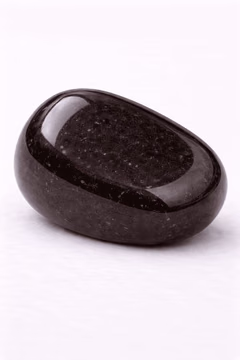
The essentials
- Family
- Garnet group
- Composition
- Fe₃Al₂(SiO₄)₃ (almandine, variable)
- Crystal system
- Cubic
- Hardness (Mohs)
- 6.5–7.5
- Color
- Red, burgundy
- Chakras
- Root
- Elements
- Fire
- Zodiac
- Capricorn
A family, not a stone
To say garnet is to name a whole group of silicates that share one crystal architecture and swap out ingredients: magnesium for pyrope, iron for almandine, manganese for spessartine, calcium for grossular and andradite. Hence a palette running from deep red to the brilliant green of tsavorite, by way of mandarin orange. Hardness sits roughly between 6.5 and 7.5 across the group.
The name comes from the Latin granatum, seeded: small red crystals packed into rock looked like pomegranate seeds. Bohemian pyrope made the fortune of nineteenth-century jewelers; today India, Sri Lanka, Madagascar and Mozambique supply most of the market. And the least glamorous garnet ends up as an abrasive: the garnet paper in a carpenter’s workshop is exactly this mineral.
Garnet, by tradition
Garnet carries the deep red of inner fire, a burgundy hue that tradition ties to the root and to vital drive. People link it to the strength to move forward, to the energy that builds confidence and feeds determination. Its dense, warm color calls to mind an ember, what animates and sets things in motion. Keep it as jewelry or in a pocket on the days you’re chasing a goal or readying for an effort. Hold it for a moment before you set off, like a reminder of your own quiet power.
Affirmation“I move forward with strength.”
The carbuncle, Sutton Hoo, and garnet bullets
Garnet is the carbuncle of medieval texts, the red stone said to shine in the dark; one Talmudic legend even has Noah’s ark lit by a carbuncle hung from the ceiling. Anglo-Saxon goldsmiths made extraordinary cloisonné work from it, as the seventh-century Sutton Hoo treasures show.
Kunz reports a rougher episode from 1892. In Kashmir, Hunza fighters shot garnet bullets at British troops, convinced they inflicted surer wounds than lead. The warrior’s stone of old belief, taken about as literally as it can be taken.
How to use garnet
Jewelry, goals, sport.
Cleansing
A rinse, smoke, sound.
Charging
Gentle sun, the earth; intention.
Common questions
- Is garnet always red?
- No. The dark red of pyrope and almandine dominates antique jewelry, but the family includes spectacular greens (tsavorite, demantoid), oranges (spessartine) and warm browns. Blue is very nearly the only color missing from the group.
- Why is garnet the January birthstone?
- The modern birthstone list was fixed in the early twentieth century by American jewelers, drawing on older traditions. Garnet, an ember-colored stone in the middle of winter, was given January, and the pairing has not moved since.
- Can garnet go in water and sunlight?
- Yes to both. It is robust, without marked cleavage, and its color is stable. Clear water or a mild soap revives the luster. The one real precaution is sudden thermal shock, which can crack stones with inclusions, so no hot water straight after cold.