Crystal healing · stone profile
Black Tourmaline (Schorl)
Black Tourmaline is a black stone traditionally linked to protection, grounding, release.
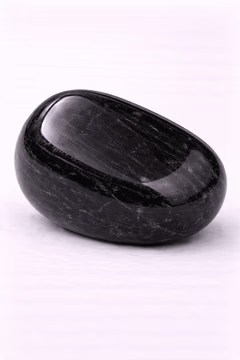
The essentials
- Family
- Tourmaline
- Composition
- Complex borosilicate (schorl)
- Crystal system
- Trigonal
- Hardness (Mohs)
- 7–7.5
- Color
- Black
- Chakras
- Root
- Elements
- Earth
- Zodiac
- Capricorn
Schorl, and a formula that reads like a shopping list
Schorl is the iron-bearing variety of tourmaline, and iron is what makes the ink-black color. It accounts for something like ninety-five percent of all natural tourmaline; the pink and green stones that get set into jewelry are the family’s exceptions, not its rule. Crystals grow as long prisms, striated down their length like blackened wood.
Its chemistry is famously tangled. John Ruskin wrote in 1890 that the formula looked more like a medieval doctor’s prescription than the makeup of a respectable mineral: boron, aluminum, iron, sodium and a crowd of other guests. Good schorl comes from Brazil, Madagascar, Pakistan and Namibia.
Black Tourmaline, by tradition
Black tourmaline is the stone of grounding and drawn boundaries. Tradition describes it as a wrapping presence that helps you feel protected and planted firmly in the ground, especially when the mood around you turns heavy. Its deep matte black calls to mind a root, a steady seat where you can set down the weight of the day. Keep it by the entrance, slip it into a pocket, or set it near your workspace. Welcome it when you need to find a sense of safety again, and let it remind you that you’re allowed to trace your own edges.
Affirmation“I feel protected and grounded.”
A stone that is genuinely electric
Tourmaline comes from the Sinhalese turamali, roughly “mixed stones,” the name given to the parcels of assorted colored gems the East India trade brought back from Ceylon around 1700. Schorl is older still, inherited from the German miners of Saxony and the village of Zschorlau.
Eighteenth-century Dutch traders called it aschentrekker, the ash-puller. Warmed near a fire, tourmaline builds an electrical charge and picks up ash and dust, which made it a handy way to clean out a pipe bowl. Pyroelectricity is a real, measurable property, and it fascinated Enlightenment natural philosophers. It also, almost certainly, seeded the stone’s later reputation for being magnetic in a mystical sense. Worth keeping the two apart: attracting ash is not a power over the world.
How to use black tourmaline
By the entrance, in a pocket, at work.
Cleansing
A quick rinse, smoke, sound.
Charging
Moonlight; the earth (buried in cloth); intention.
Common questions
- Does black tourmaline block EMF or negative energy?
- No. Its pyroelectricity is real but it stops at picking up dust when the stone is warmed, and “negative energy” is not a physical quantity anyone can measure. No study has found an effect from crystals beyond placebo either, Christopher French’s 2001 experiment included. Its value is the threshold it marks, the ritual, the attention you pay yourself.
- Where do people put black tourmaline?
- By the front door is the classic, kept as a kind of doorkeeper, or in a pocket on days that will ask a lot of you. In a collection it plays the role of the foundation: the piece you come back to after something has left you scattered.
- Can black tourmaline go in water and sun?
- Both, without worry. At 7 to 7.5 on the Mohs scale it is hard, and black cannot fade. A rinse and a dry cloth cover routine care. Tradition prefers to cleanse it in earth, buried a few hours in a pot or the garden, which suits its grounding symbolism.
- How do I tell tourmaline from obsidian and onyx?
- Three black stones, three different natures. Tourmaline is a crystal with lengthwise striations and a slightly matte look; obsidian is glossy volcanic glass with sharp conchoidal breaks; onyx is smooth, even chalcedony. Under a loupe, those parallel grooves on the schorl are the giveaway.