Crystal healing · stone profile
Smoky Quartz
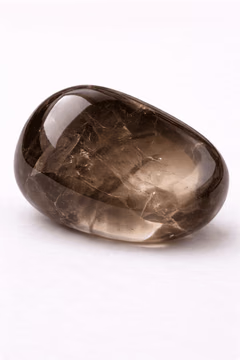
Smoky Quartz is a translucent brown to black stone traditionally linked to grounding, protection, release.
The essentials
- Family
- Quartz (brown variety)
- Composition
- SiO₂
- Crystal system
- Trigonal
- Hardness (Mohs)
- 7
- Color
- Translucent brown to black
- Chakras
- Root
- Elements
- Earth
- Zodiac
- Capricorn
Smoke made by radiation, very slowly
Smoky quartz is chemically the same as rock crystal: silicon dioxide, nothing added. The color has an unusual origin. Traces of aluminum sitting in the lattice are turned into color centers by the natural radiation of the surrounding rock, often weakly radioactive granite. It takes thousands of years of that quiet bath to smoke a crystal. The darkest variety, almost opaque, is called morion.
The Alpine fissures of Switzerland and Austria yield famous crystals, as do Brazil, Madagascar, Colorado and the Cairngorm mountains of Scotland. One market note worth having: a share of commercial smoky quartz is rock crystal irradiated artificially in a lab. The process imitates the natural one, but a very dark, perfectly uniform, cheap stone has a good chance of having been through it.
Smoky Quartz, by tradition
Smoky quartz carries a translucent brown hue, almost smoke-touched, and tradition sees it as a grounding stone that helps you set your feet back on the ground. People credit it with taking in what weighs on you so you can let it drift off, the way you release a sigh after a long day. It’s lovely to hold in the hollow of your hand late in the evening, when you feel the need to shed the load you’ve gathered. Keep it in a pocket on dense days, or set it near you during meditation to feel steadier and more present. Its dark color invites calm and a gentle letting go.
Affirmation“I release what weighs me down.”
Alpine crystal hunters and twelfth-century sunglasses
In the Alps, smoky quartz is the crystal hunters’ stone. For centuries the Strahler have opened the “ovens” in granite walls, sometimes roped above a drop, to bring out spectacular brown groups. In Scotland it is cairngorm, named for the range where it was gathered, and it sits in kilt brooches and on the pommels of sgian-dubh. Victorian enthusiasm for all things Highland made it fashionable across Europe.
Something less expected: twelfth-century China cut flat panes of smoky quartz to wear in front of the eyes. Protection from glare, yes, but not only. Judges are reported to have used them to keep their expressions unreadable during hearings. Sunglasses, several centuries early, ground from mountain crystal.
How to use smoky quartz
Pocket, meditation, the end of the day.
Cleansing
A rinse, smoke, sound.
Charging
The earth (in cloth), moonlight; intention.
Common questions
- Does smoky quartz fade in sunlight?
- Over time, yes. The color centers built by natural irradiation are undone by heat and prolonged ultraviolet. A few hours change nothing; months on a south-facing sill will lighten it. Charge it by moonlight instead, which suits its quiet, shadowed register anyway.
- How can I tell natural smoky quartz from irradiated?
- By eye it is genuinely hard, because the laboratory process reproduces the natural mechanism. A few hints help: very dark, perfectly even color on an inexpensive stone points to treatment, while natural crystals usually show lighter and darker zones within the same piece.
- Is smoky quartz radioactive?
- No. The radiation that colored it came from the rock around it over geological time and left nothing behind; the crystal is inert silicon dioxide. The same is true of laboratory-irradiated material, which is held until any induced activity has decayed before it can be sold.
- What is smoky quartz used for?
- Tradition reads it as the night version of clear quartz: the same transparency, crossed by shadow. It is the stone people reach for in overloaded stretches, too many ideas, too many screens. It stands for ballast, and for finishing what is already open rather than starting something else.