Crystal healing · stone profile
Amethyst
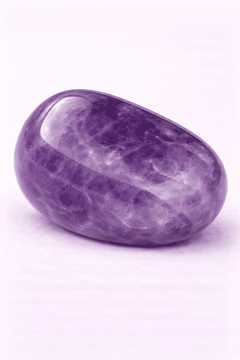
Amethyst is a violet stone traditionally linked to calm, intuition, protection.
The essentials
- Family
- Quartz (purple variety)
- Composition
- SiO₂ (quartz)
- Crystal system
- Trigonal
- Hardness (Mohs)
- 7
- Color
- Violet, mauve
- Chakras
- Crown, Third eye
- Elements
- Air, Ether
- Zodiac
- Pisces, Aquarius, Virgo
What actually makes amethyst purple
Amethyst is quartz, plain silicon dioxide, chemically identical to the clear rock crystal sitting next to it on the shelf. The violet is not a pigment. Traces of iron sit in the lattice, natural radioactivity in the surrounding rock works on them over millions of years, and the result is a set of color centers that swallow part of the spectrum and let the purple through.
It grows mostly inside volcanic geodes, hollow pockets lined with crystal points. Brazil, and Rio Grande do Sul in particular, is the great supplier; Uruguay produces the deepest violets, and Zambia and Madagascar send fine material too. Some Brazilian geodes come out of the ground taller than the person standing beside them.
Amethyst, by tradition
Amethyst is the stone of calm and stepping back. Tradition links it to a mind that settles and an intuition that starts listening again, once the inner chatter agrees to hush. Keep it by the bed or hold it in meditation, like an invitation to slow down. Its violet hue speaks to that shift from doing to feeling, from outside to within. Set it wherever you’re after a little quiet, and let it remind you to breathe.
Affirmation“I quiet my mind and listen to my intuition.”
From Greek wine cups to bishops’ rings
The name is a promise the Greeks made about it: amethystos, “not intoxicated.” Wine was drunk from amethyst cups on the understanding that the stone kept a clear head. The nymph story, in which a young woman is turned to crystal and Dionysus stains her with wine, is far younger than it sounds. It was written by the French poet Remy Belleau in the sixteenth century, not handed down from antiquity.
George Frederick Kunz, Tiffany’s gemologist, reported in 1913 that it had long been the bishop’s stone, worn on the hand as a sign of spiritual sobriety. Until the early nineteenth century it was priced alongside ruby. Then Brazil opened up, and a stone that had belonged to cathedrals turned into one anybody could own.
How to use amethyst
Meditation, bedside table, jewelry (keep out of long direct sun).
Cleansing
A quick rinse, smoke, sound, visualization.
Charging
Moonlight, a quartz cluster, intention; skip long full sun.
Common questions
- Can amethyst go in water?
- A rinse is completely fine. Quartz is hard and insoluble, and a few seconds under the tap will not touch it. Skip salt water, which creeps into micro-fractures and dulls the polish, and skip long soaks for set jewelry, since the metal and the glue mind it more than the stone does.
- Why has my amethyst gone pale?
- Light, almost every time. Ultraviolet undoes the color centers that iron and natural irradiation built, and the fading does not reverse. A piece living on a south-facing windowsill will drift toward gray over a few years. This is the same reaction, gently applied, that turns amethyst into most of the citrine on the market.
- Is amethyst a rare stone?
- Not anymore, and that is a recent shift. Before the Brazilian and Uruguayan deposits were worked, it carried ruby prices. Today fine deep-violet material still commands real money, especially clean Uruguayan color, but ordinary amethyst is one of the most affordable crystals you can buy.
- Does amethyst really calm you down?
- No study has shown any effect from crystals beyond placebo; the psychologist Christopher French tested it cleanly in 2001, handing volunteers real crystals and indistinguishable fakes and getting the same reported sensations from both. What amethyst offers sits elsewhere: the symbol, the ritual, the few minutes of attention you give yourself with a beautiful object in your hands.