Crystal healing · stone profile
Celestite
Celestite is a pale blue stone traditionally linked to calm, intuition.
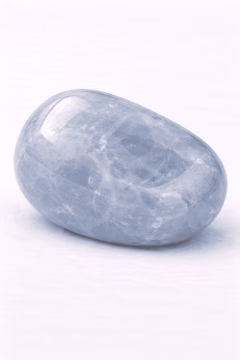
The essentials
- Family
- Sulfate
- Composition
- SrSO₄
- Crystal system
- Orthorhombic
- Hardness (Mohs)
- 3–3.5
- Color
- Pale blue
- Chakras
- Crown
- Elements
- Air/Ether
- Zodiac
- Libra
The sky-blue mineral that makes fireworks red
Celestine, to give it its mineralogical name, is a strontium sulfate, and it is in fact the world’s principal source of strontium. The irony is a lovely one: the bluest mineral in the kingdom supplies the element that colors fireworks red. Its own blue is generally put down to subtle defects in the lattice, built up by natural irradiation over geological time.
The geodes you see in shops come almost entirely from Sakoany, near Mahajanga in Madagascar: pockets of translucent crystals sitting in a gray matrix. Fine celestine also comes from Mexico, from Ohio and from the United Kingdom. At 3 to 3.5 on the Mohs scale, with perfect cleavage, it scratches under a determined fingernail and chips at the slightest knock.
Celestite, by tradition
Celestite is a piece of sky resting in your hand. Tradition ties it to softness, to soothing, and to a kind of airy peace. Its pale blue calls to mind the calm of morning, when nothing is in a hurry yet. Keep it in a corner of the bedroom or the meditation space, like a quiet presence. Rest your eyes on it when the mind stirs and you’re trying to breathe higher.
Affirmation“I connect with calm.”
From Werner to a geode you can walk into
The mineral was named at the end of the eighteenth century, when Abraham Gottlob Werner christened it after the Latin caelestis for that winter-sky blue. For a long time it was confused with baryte, its barium cousin, which takes an analysis to tell apart with certainty.
Its best story is American. In 1897, at Put-in-Bay, on South Bass Island in Lake Erie, workers digging a well beneath a winery cellar broke into what is now called Crystal Cave: a celestine geode large enough to stand up inside, lined with crystals that can approach a meter across. It remains the largest known geode in the world, and you can still visit it.
How to use celestite
A meditation corner; avoid jewelry.
Cleansing
Sound, smoke; a dry cloth.
Charging
Moonlight; intention.
Common questions
- Celestite or celestine: which is correct?
- Both name the same mineral. Celestine is the official mineralogical term; celestite is the form popularized by the crystal trade. You can use either without being wrong, though a museum label will say celestine.
- Why has my celestite geode faded?
- Light, almost always. The blue is sensitive to ultraviolet, and regular sun exposure, even through a window pane, bleaches it irreversibly. Put it somewhere bright but out of direct sun, and it will keep its color for decades.
- How do I clean a celestite geode?
- A soft brush and a dry cloth. Do not soak it: water can work into the matrix behind the crystals and weaken the whole piece, and the crystals themselves chip easily. This is display-case material rather than pocket material.
- Does celestite help you sleep?
- Nothing demonstrates it; no study has shown any crystal effect beyond placebo, per Christopher French in 2001. A ritualized bedtime does settle people, and a geode on the nightstand is the reminder of that ritual rather than its cause. Which is still a reasonable thing for an object to be.