Crystal healing · stone profile
Lepidolite
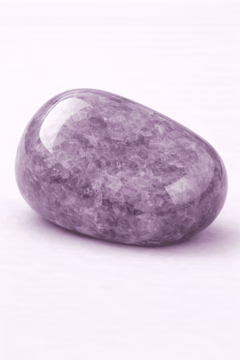
Lepidolite is a lilac stone traditionally linked to calm, release, self-love.
The essentials
- Family
- Mica (lithium)
- Composition
- Li-rich mica (variable)
- Crystal system
- Monoclinic
- Hardness (Mohs)
- 2.5–3
- Color
- Lilac, pink-violet
- Chakras
- Crown, Heart
- Elements
- Air/Water
- Zodiac
- Libra
A stone made of stacked pages
Lepidolite belongs to the micas, silicates built in sheets so fine you can sometimes lift one with a fingernail. Its lilac comes from traces of manganese, and its pearly, almost glittering luster from the thousands of platelets throwing light back at you. At 2.5 to 3 on the Mohs scale it is among the softest stones in any shop.
It grows in pegmatites, the coarse rocks where rare elements gather, often in the company of pink tourmaline and quartz. Notable deposits sit in Brazil’s Minas Gerais, in Madagascar, in California and in the Czech Republic. It is also a lithium ore, which has made it strategically interesting again in the age of batteries.
Lepidolite, by tradition
Lepidolite shades into lovely tones of lilac and pink-violet, and tradition sees it as a soothing stone that invites you back to calm. People credit it with walking alongside letting go, like a settled breath that helps rest the mind at the end of the day. It’s a stone many keep for the evening or for meditation, when it’s time to release the tension you’ve gathered. Hold it in your hand before sleep, and let its intention remind you that you’re allowed to slow down and be gentle with yourself. Its tender hue invites serenity and kindness toward yourself.
Affirmation“I let go and come back to calm.”
From “lilac stone” to the periodic table
It was first called lilalite, the lilac stone, until the chemist Martin Heinrich Klaproth renamed it lepidolite in 1792 from the Greek lepidos, scale, in tribute to its layers. The poetic name lost; the accurate one stayed.
Its finest hour came in 1861. Analyzing a Saxon lepidolite with a spectroscope, Robert Bunsen and Gustav Kirchhoff found an unknown element in it: rubidium, a year after they had isolated cesium. This small lilac mica enlarged the periodic table, which is not nothing for a stone now sold as a companion for slow evenings.
How to use lepidolite
Evening, meditation; avoid exposed jewelry.
Cleansing
Sound, smoke; a dry cloth.
Charging
Moonlight; intention.
Common questions
- Lepidolite contains lithium. Does it work like the medication?
- No. The lithium is locked inside an insoluble silicate; holding the stone, wearing it or sleeping beside it releases nothing measurable. Medical lithium is a salt dosed to the milligram under supervision, an entirely different thing. And no study has found an effect from crystals beyond placebo, as Christopher French’s 2001 experiment demonstrated.
- Why is my lepidolite flaking?
- Because it is a mica: a stack of soft sheets that separate under friction, water or a knock. That is its nature, not a fault in your piece. The very shiny compact pieces on the market are often stabilized or naturally intergrown with quartz, which makes them tougher.
- Can lepidolite go in water?
- No. The layers open, the surface goes dull and the stone can literally delaminate. Salt is worse. Keep it to a dry soft cloth, and use smoke or a rest on a quartz cluster if you want a cleansing ritual.
- Does lepidolite fade?
- Yes, in strong light. Like many manganese-colored stones its lilac pales under ultraviolet over time. Moonlight is the traditional choice for charging it, which happens to be the right one for the mineral too.