Crystal healing · stone profile
Rose Quartz
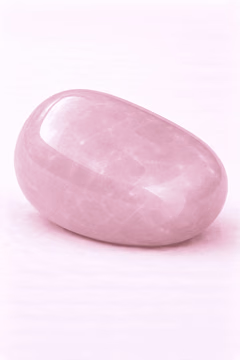
Rose Quartz is a pale to deep pink stone traditionally linked to self-love, calm, optimism.
The essentials
- Family
- Quartz (pink variety)
- Composition
- SiO₂ (quartz)
- Crystal system
- Trigonal
- Hardness (Mohs)
- 7
- Color
- Pale to deep pink
- Chakras
- Heart
- Elements
- Water
- Zodiac
- Taurus, Libra
A pink that took two centuries to explain
Rose quartz kept mineralogists guessing for a long time. Titanium was blamed, then manganese. Modern analysis settled it differently: the color comes from microscopic fibrous inclusions, close in nature to dumortierite, scattered through the crystal. Those fibers also explain why the stone is nearly always milky and translucent rather than glass-clear.
Unlike amethyst, it rarely builds tidy crystals. It turns up as massive blocks in pegmatites, the coarse-grained rocks where rare elements gather. Minas Gerais in Brazil and Madagascar are the main sources, with Maine contributing on the American side. Madagascar in particular yields the softest, most powdery pinks.
Rose Quartz, by tradition
Rose quartz is the stone of tenderness toward yourself. Tradition ties it to a heart that opens, to the softness you offer yourself when you tend to be hard on you. Its pink, sometimes pale and sometimes deep, carries a quiet warmth you can take in without bracing. Rest it on your chest in meditation, keep it in a room you live in, or wear it as jewelry. Welcome it as a patient nudge to speak to yourself with compassion, the way you would for someone you love.
Affirmation“I treat myself with gentleness and compassion.”
Ancient beads, modern symbolism
People have been shaping it for a very long time. Rose quartz beads from Mesopotamia have been dated to around 7000 BC, and Assyrian and later Roman workshops cut it into jewelry and seals. As a material it is genuinely old.
Its reputation as the love stone is not. The tale of Eros bringing rose quartz down to humankind comes almost entirely from modern books, and the heart symbolism we now take for granted was assembled through the twentieth century, gathering real momentum with the New Age current of the 1970s. Knowing that makes the stone more interesting, not less: you can watch a tradition being written.
How to use rose quartz
Over the heart in meditation, jewelry, a lived-in room.
Cleansing
A quick rinse, smoke, sound.
Charging
Moonlight; a quartz cluster; skip long full sun.
Common questions
- How do I know my rose quartz is real?
- Dyed glass is the usual imposter. Look through a loupe for small round bubbles, which glass has and quartz does not, and trust temperature: real stone stays cool in the hand far longer. A slightly uneven, milky pink is a better sign than a flawless uniform one.
- Does rose quartz fade?
- Yes, and this is the one thing worth protecting it from. Heat and direct sun drain the pink, and it does not come back. Keep it off the sunny windowsill, out of the car, away from the radiator. Water is no problem at all; light is.
- Where should I keep rose quartz?
- Tradition puts it in the bedroom or on the nightstand, close enough to notice. The point is less placement than reminder: a physical marker for an intention you can otherwise forget, which is to be a little less hard on yourself. Held over the heart in meditation is the other classic.
- Can rose quartz attract love?
- No study has shown any crystal effect beyond placebo, as Christopher French demonstrated in 2001. Wearing rose quartz will not change other people. It can change the way you look at yourself, which is already a great deal, and that shift belongs to you rather than to the stone.