Crystal healing · stone profile
Black Obsidian
Black Obsidian is a black stone traditionally linked to protection, grounding, release.
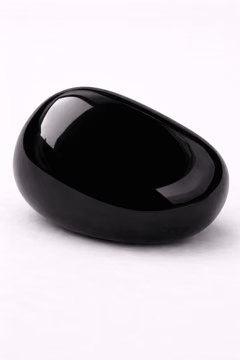
The essentials
- Family
- Volcanic glass
- Composition
- Silica-rich (variable)
- Crystal system
- Amorphous
- Hardness (Mohs)
- 5–5.5
- Color
- Black, sometimes with sheen
- Chakras
- Root
- Elements
- Earth/Fire
- Zodiac
- Scorpio
Not a crystal at all
When silica-rich lava meets air or water it freezes before its atoms have time to arrange themselves. What is left is glass, amorphous like the glass in your windows but made by a volcano. So obsidian is technically not a mineral and certainly not a crystal; it is a mineraloid, and that takes nothing away from it.
Its conchoidal fracture, breaking in shell-shaped curves, produces edges of extraordinary fineness. The named varieties come from what is trapped inside: snowflake obsidian owes its gray flecks to cristobalite, rainbow obsidian its sheen to microscopic inclusions that diffract light, and Apache tears are rounded nodules weathered free of their matrix. Deposits follow the volcanoes: Mexico, Armenia, Iceland, the Lipari islands, the western United States, Ethiopia.
Black Obsidian, by tradition
Black obsidian was born of volcanic glass, smooth and deep like a dark mirror, and tradition treats it as a keeper of boundaries. People credit it with helping you set a clear frame when the mood around you turns heavy, like a discreet shield you keep close. It’s a grounding stone many slip into a pocket to feel steadier in tense moments. Keep it with you through a delicate situation, or hold it during a short meditation to stand for what you choose to release. Its blackness invites you back to yourself, settled and firmly planted.
Affirmation“I keep healthy boundaries.”
Prehistoric trade routes and John Dee’s mirror
The name comes from Pliny, who credits its discovery to one Obsius in Ethiopia, but the story starts far earlier. From prehistory onward obsidian was traded over hundreds of kilometers, and archaeologists use those movements to trace the earliest known trade routes. A freshly struck blade carries an edge finer than a steel scalpel; surgeons tested obsidian scalpels in the twentieth century.
Among the Aztecs it armed warriors and equipped diviners: Tezcatlipoca, the Smoking Mirror, takes his name from it. One Aztec obsidian mirror, brought to Europe after the conquest, ended up in the sixteenth century in the hands of John Dee, astrologer to Elizabeth I, who used it for scrying. It is in the British Museum today.
How to use black obsidian
Pocket when the mood is heavy; a short meditation.
Cleansing
A rinse, smoke, sound.
Charging
The earth, moonlight; intention.
Common questions
- Is obsidian too intense for beginners?
- That is the reputation the tradition gives it, describing a stone that confronts rather than comforts. Nothing of the kind has ever been measured; no study has shown any crystal effect beyond placebo, per Christopher French in 2001. If an obsidian stirs something in you, that is your own attention working, and it is worth paying attention to. Go at your own pace.
- How do I know my obsidian is natural?
- This is the tricky one, since obsidian is glass and manufactured glass looks a lot like it. Be wary of bright, even colors sold as “blue obsidian” or “apple green,” and of rows of round bubbles, which are typical of factory glass. Black, snowflake and rainbow pieces from serious dealers are usually genuine.
- Can obsidian go in water?
- Yes, without difficulty. It is glass, indifferent to water and to dissolved salt. Avoid sudden temperature swings, which can crack it, and knocks against a hard sink, which chip the edges. Handle rough pieces with respect: those edges genuinely cut.
- Why is obsidian called a mirror stone?
- Partly because polished black glass really does reflect, and partly because that is exactly what it was used for, from Aztec scrying mirrors to Dee’s. Contemporary practice keeps the image and turns it inward: a stone said to return, without softening, whatever you have been avoiding looking at.