Crystal healing · stone profile
Tiger’s Eye
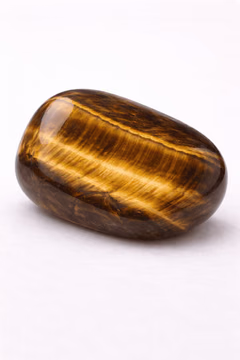
Tiger’s Eye is a golden brown stone traditionally linked to confidence, grounding, focus.
The essentials
- Family
- Quartz (pseudomorph)
- Composition
- SiO₂ (quartz)
- Crystal system
- Trigonal
- Hardness (Mohs)
- 7
- Color
- Golden brown, chatoyant
- Chakras
- Solar plexus
- Elements
- Fire/Earth
- Zodiac
- Leo, Gemini
Silk made of stone
Tiger’s eye begins where two minerals meet. Fibers of crocidolite, a blue mineral, get caught in quartz and then oxidize; the iron released stains the fibers gold and brown. The chatoyancy comes straight from that geometry: light reflecting off thousands of parallel fibers, exactly as it does across a spool of silk. Turn the stone and the band of light slides.
The historic deposits are in the Griqualand region of South Africa, which still supplies most of the market, with Western Australia contributing as well. When the fibers stay blue rather than oxidizing, the same stone is called hawk’s eye: same family, a different eye.
Tiger’s Eye, by tradition
Tiger’s eye is the stone of settled assurance. Tradition links it to a quiet courage, to the ability to choose your actions and hold your course when a challenge shows up. Its golden brown, run through with chatoyant flashes that ripple in the light, calls to mind a calm, determined gaze. Slip it into a pocket before a moment that asks for nerve, wear it as jewelry day to day. Hold it for a beat when you want to find your footing and your will again, and let it remind you that you know how to move forward step by step, with discernment.
Affirmation“I choose my actions with assurance.”
From Roman amulet to the most affordable stone in the case
Roman soldiers are said to have carried engraved tiger’s eye amulets into battle, on the logic that an eye keeps watch while yours is busy elsewhere. Whatever the truth of that, the stone stayed rare and expensive in Europe well into the nineteenth century.
Everything changed in the 1880s, when South African material arrived on the market in quantity. The price collapsed and tiger’s eye went from coveted gem to popular stone almost overnight. That is precisely why it is now one of the easiest and cheapest places to begin a collection, and why a good piece costs a fraction of what it once did.
How to use tiger’s eye
Jewelry, a pocket before a challenge.
Cleansing
A rinse, smoke, sound.
Charging
Gentle sun, moonlight; intention.
Common questions
- What is the difference between tiger’s eye, hawk’s eye and bull’s eye?
- One stone at three stages. Hawk’s eye keeps its original blue fibers. Tiger’s eye is the oxidized golden version. Bull’s eye, sometimes sold as red tiger’s eye, is tiger’s eye that has been heated, either in the ground or in a workshop, and turned reddish brown.
- Tiger’s eye contains asbestos. Is it safe?
- Crocidolite is indeed a form of asbestos, which understandably worries people. In a polished stone the fibers are sheathed in quartz and stable, so handling, wearing and holding a finished piece is not the issue. The concern belongs to lapidaries cutting rough material dry, who work with dust extraction for exactly this reason.
- Can tiger’s eye go in water and sunlight?
- Yes to both. It is hard, its color holds up to light far better than amethyst does, and a rinse and a dry cloth are all it needs. Tradition likes to charge it in morning sun, which suits its whole solar-plexus register.
- Is tiger’s eye good for confidence?
- Tradition ties it to the solar plexus and to standing your ground, and it is the stone people slip into a pocket before an interview. Nothing beyond placebo has ever been measured, as Christopher French’s 2001 test showed. The steadiness is yours; the stone is the reminder you agreed to carry.