Crystal healing · stone profile
Labradorite
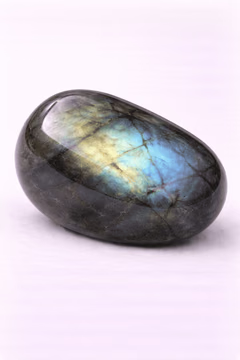
Labradorite is a gray stone traditionally linked to protection, intuition, creativity.
The essentials
- Family
- Plagioclase feldspar
- Composition
- (Ca,Na)(Al,Si)₄O₈
- Crystal system
- Triclinic
- Hardness (Mohs)
- 6–6.5
- Color
- Gray, iridescent flashes
- Chakras
- Third eye
- Elements
- Water/Air
- Zodiac
- Sagittarius
Why it flashes when you tilt it
Labradorite belongs to the feldspars, the most widespread mineral family in the Earth’s crust. Its flashes are not pigment at all. As the crystal cooled it separated into alternating microscopic lamellae, on the order of 150 nanometers thick, and light bouncing between those layers interferes with itself the way it does on a soap bubble. Bøggild explained the mechanism in 1924, and the effect carries the stone’s name: labradorescence.
The historic deposit sits on the Labrador coast in Canada. Madagascar now supplies most of the material in shops, and Finland produces spectrolite, a dark variety that throws the full spread of colors rather than the usual blue and gold.
Labradorite, by tradition
Labradorite is the stone of the threshold, the one that protects while keeping the mind open. Tradition ties it to a watchful intuition and to the knack for holding your boundaries without closing off to others. Its quiet gray hides blue and green flashes that light up with the angle of the light, like an aurora held inside the stone. Wear it as jewelry, slip it into a bag, hold it in meditation to listen to what’s stirring within. Welcome it when you’re navigating between opening up and protecting yourself, and let it remind you that you can stay warm without losing yourself.
Affirmation“I hold my boundaries while staying open.”
Trapped northern lights, and an anti-tank ditch
Moravian missionaries described it in 1770 on the Isle of Paul, off the Labrador coast, though Inuit communities had long known the stone. Their story is the better one: the northern lights were caught inside the rock, a hunter struck it with his spear and set most of them free, and what stayed behind is still shining in the stone you are holding.
Spectrolite has a blunter origin. It was found in 1940 in southeastern Finland while anti-tank fortifications were being dug. The geologist Aarne Laitakari named it, and the small town of Ylämaa has made it a specialty ever since. Two discoveries, two hundred years apart, both accidental.
How to use labradorite
Jewelry (mind the knocks), meditation, a bag.
Cleansing
Smoke, sound; a quick rinse is fine, then dry.
Charging
Moonlight; intention; avoid long sun.
Common questions
- Why doesn’t my labradorite flash anymore?
- Two likely reasons. Angle: labradorescence only appears within certain orientations, so turn the piece slowly under a lamp before concluding anything. Or wear: micro-scratches on the polish scatter the light. A lapidary repolish often brings back a flash people assumed was gone for good.
- Is rainbow moonstone the same as labradorite?
- Close, and the naming is loose. What the trade calls rainbow moonstone is a white labradorite, a cousin in the same feldspar family, whose sheen plays in blues and multicolored iridescence. It is not a scam, but mineralogically it sits with labradorite rather than with true moonstone.
- How should I care for labradorite?
- More gently than quartz. Feldspars have cleavage planes, lines of weakness a sharp knock can split. Keep it away from other jewelry, skip ultrasonic cleaners, and use a brief rinse rather than soaking. No salt and no household products: the polish carries the whole effect, and it dulls faster than quartz would.
- Does labradorite protect empaths?
- That is what the tradition reads into it. Measured against controls, crystals have never shown an effect beyond placebo, Christopher French’s 2001 experiment included. Setting a boundary stays your own work. What the stone can do is remind you, prettily, that you had decided to set one.